Sunday, May 2, 2010

LETTER XXIV: New Eyes On The Ground

March 2010
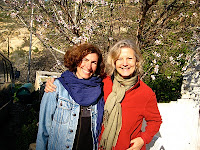
And then came Alyce Faye Eichelberger Cleese.

We are trustees of the Esalen Institute, and like rooming together at board meetings. Making connections between Jordan and California is not terribly difficult. Lots of golden, rolling hills that turn green with rain – and we had good rain here this winter. Hiking. Adventure trails. Desert. Good coffee. A penchant for kicking back. And natural hot springs. In fact Jordan is one of the few places in the world besides Esalen that boasts the coming together of the Earth’s three waters: salt water, fresh water, and hot springs.

There are big differences, too, of course. Most obvious is the absence of ocean. Our (very salty) Dead Sea (into which the hot springs and cold creeks run) has two visible shores and very little surf. No otters or whales or anything that breathes underwater.

And making me quite at home there’s a rooster on the Esalen campus in Big Sur, California, too. It doesn’t understand that the sun will come up with or without its crowing; it also crows throughout the night in hope. Alyce Faye and I grew to loathe the rooster since usually we were up late and wanted to squeeze in as many extra minutes of sleep as possible before our own early swim in the pool and mad, freezing cold dash to the hot tubs where we luxuriate before breakfast and hours of reports and spread sheets. We called the rooster “Cheney.”

Alyce Faye has a very good eye. Our favorite public beach at the Dead Sea looks like a five star resort.


My bedouin friends, Manal and her brother Ismail at Petra, made us tea on the high cliffs leading to the Deir (Monastery).


Not to mention visiting Samaher Khameis's special mosaic workshop in Madaba. Samaher teaches at the Institute for Mosaic Art and Restoration in Madaba. My short film on the Institute will be on YouTube soon.


And she didn't miss charming downtown Amman.

This was Alyce Faye's first visit to an Arabic-speaking nation; like most people who come here, she loved it. Ambassadors all of us, who return assuring Americans that it’s safe, friendly, respectful of women, respectful of people of varying faiths, easy to get around, visually compelling, and fun. Of course that sentence is laden with generalities, but generally they are true.

Anywhere we go the evil and nasty is an exception. Except, it seems, when we go to the front page of newspapers or to top-of-the-hour headline news. (Whoops! No offense to my dear friends in media who struggle to balance accuracy, information, commercial interests, subjectivity and good writing every day.)

Peter arrived while Alyce Faye was here and we all went to Lebanon.

SEE "NEW EYES" PART TWO.


Monday, April 19, 2010

LETTER XXIII: If it's Thursday it must be Cairo

March 27, 2010

If you go to the pyramids and your camera deletes all of your photos, did you really see the Sphinx? Those great gimmicky shots from far enough away so it looks like you are holding Cheops by the tip, or blowing a kiss at the big, human-headed cat. And the shots we took in the deep dark recesses of the Queen’s tomb where “No Photographs” is prominently displayed … A smooth few Egyptian pounds to the guy guarding the door makes that all possible. Maybe an offended Queen cursed the flash drive? Or was she jealous of that buff, big man of Memphis, Ramses II?

We were mighty sad to lose those photos but not at all disappointed with our Egyptian experience (except for missing our friends Neil and Trudie Prior there by about 10 hours!). Sufia Lodhi and Yasir Khan (his name is Khan and he is not a terrorist; he is broadcast journalist and involuntary comedian) welcomed us to the guest room in their lovely Maadi apartment. Katie and I had the honor of being the last guests there before they move to Doha, Qatar, where Yasir is starts a new job with Al Jazeera. After he worked on my “Inside Mecca” team, Yasir took a position at the American University of Cairo. Lucky students. Sing to the class if you’re late. Cell phones confiscated if used. Failing grades given as deserved. And a hell-of-an education in production.

Day One was Giza, Memphis, the Saqqara “step” pyramid, and as touristy a lunch as I’ve ever had. But for the lunch the day was fascinating. The tourists at the restaurant were boring. Seen one, seen ‘em all. To be among them eating elementary Egyptian food was hard to swallow but chalked now up to experience. I am deeply privileged to have traveled as a reporter or as family. The world looks differently when you are greeted with an authentic smile of greeting or a deeply skeptical grimace, when you have the back roads to trek and small alleys to shop. No matter how you see them, though, the pyramids are incomparable: still gasp-worthy after all these years. New for me was the hunk Ramses II, especially in his Memphis museum (not as in the photo here). Lying on his back, as the granite statue was found, his muscular shoulders look ready to hunt or hug; his nose is smooth and proud, chin authoritative, eyes gentle, beard coiffed, legs and calves toned to perfection. The loincloth was too heavy to peek underneath.

Recently renovated Fatimid, Mamluke and Ottoman mosques not far from Al Azhar and Khan Khalili are open again; lining a street we nicknamed “Islamic Cairo,” but of course much of Cairo is “Islamic,” and its mosques and monuments pierce the skyline from the Citadel with not-the-boxer-Muhammad Ali-mosque, to the many inhabited shrines of the City of the Dead. Although the architecture of these particular mosques was far from Nabatean, I saw shades of Petra on this bustling, shaded, beautifully sculpted street. It was the patrons and tombs. “Remember me!” booms from the statues of Ramses, from Petra’s Khaznah or “Treasury,” and from the finely adorned, inlaid and filigreed walls and ceilings of these exquisitely restored mosques. Today patrons tend to prefer performing arts centers and sports stadiums – places of the living to anoint their posterity. But for centuries humans raised and praised the dead.

Katie, Sufia and I prayed ‘Asr at Al Azhar that Friday. ‘Asr is the afternoon prayer, not the big crowded congregational prayer that so often is filmed for news reports to fill in video during stories about acts of violence committed by Muslims. The women’s section at Al Azhar was crowded but not stifling. Most importantly, Katie and Sufia talked about religion and faith and the inconsistencies of the twain and practice. Sufia was banished from Islamic “Sunday school” in St. John, New Brunswick, Canada, for asking too many questions; Katie keeps her mouth shut and is getting “A”s in her religion class at Modern American School. But they have the same concerns, mostly to do with hypocrisy, priority, patriarchy, and complacency. I am glad Katie has another adult to hear her. She is blindingly brave, innocently courageous, subjecting herself to the contrary lessons of theoretical Islam and its manifestations. One day she will see, insha Allah, how this experience sharpened her wit and wisdom; meantime she either suffers in silence or has transcendent moments with people like Sufia or her English teacher, Ms. Aisha. Ms. Aisha is Welsh. She told me, “If I’d come to Jordan before embracing Islam I’d never have become Muslim.”

Somewhere between the Mamlukes and Azharis is a bronze souk. I am now determined to buy a bronze minaret cap for our Maplewood garden. (See photo above.)

March 27 is another birthday for my mother. Tonight, as we enjoy Egyptian take out with friends, mom, Pete Bolton, and Janna dine at the Rose Tatoo in Philadelphia. Peter joins board members of the Shakespeare Theatre of New Jersey at the second annual trustee dinner at Bob and Buena Chilstrom’s home, celebrating also the arrival of twins to our great education director Brian Crowe and his partner Walt.

God bless them all.

Thursday, March 18, 2010

Amplifying the Voice of Muslim Women: A Review of Brigid Maher’s “Veiled Voices”

“Veiled Voices” is a film filled with loud, bright stories that enlighten an audience in need of authenticity about Islam in general and the lives of Muslim women in particular. Brigid Maher, director, cinematographer and editor, shows sensitivity and skill in bringing these critical-yet-simple stories to light.

Simple? Yes. They are stories of the woman next door: a neighbor who is a mother and wife; a professional who teaches and travels; an individual facing challenges and disappointments who does not yield to inaction but rather overcomes and inspires. These stories unfold gradually as they weave together across borders.

Maher profile s three women: Huda Al Hasbash from Syria, Suad Saleh in Egypt and Ghina Hammoud of Lebanon. These stories are woven together, each round deepening the contours of their lives. We meet them first as professionals, then as wives or divorcĂ©es, then as mothers and cooks, balancing the many duties women have worldwide. We meet their husbands, mothers and children. Each round widens the panorama of women’s experience in these Arab and Muslim-majority countries.

Syrian mother and educator Al Hasbash defends wearing a headscarf and goes on to demonstrate that there need be no conflict between wearing a scarf and living a modern life. She teaches dozens of women not only to read Qur’an, but to know their rights. And she sizzles up a fine looking meal for her family while she’s describing her views to camera.

Dr. Saleh is a very public person, teaching at Cairo’s Al Azhar University and appearing on television call-in programs. “We have reduced Islam to a veil and a beard,” she laments, when there is so much more. Having reported on Islam and Muslims for 20 years I confirm her complaint. This is a problem perpetuated in part by Muslims themselves.

Hammoud bravely sticks with her career in spite of betrayal by her husband; she keeps the affection and respect of her daughters who lived with their father after the parents divorced. Students deeply appreciate the model she provides.

Relationships between women and men are good examples of ongoing stereotypes. Due in part to mainstream media, pop culture, and ignorance, a prevailing view is one of oppression of women. We read of “honor killings,” of girls forbidden to go to school, and women prevented from divorce in unacceptable situations. None of these is permitted in Islamic law, even if culture in some Muslim-majority countries turns a blind eye. We feel for Ghina Hammoud who suffered years in an abusive marriage. In contrast, Huda Al Habash’s husband Samir Khalidi is the picture of an ideal partner. He appreciates and supports her calling and is helpful at home, clearing the table and going over homework with one of their sons. Dr. Saleh notes that while she may be qualified to sit on Egypt’s higher Islamic council, the reality is that the men who have the vote will not receive her. Susan B. Anthony had to struggle, too. Without a cudgel, Maher hammers home the point that Muslim women have rights, can be self-expressed, and like their sisters around the world, must overcome hurdles in their lives to accomplish their goals – even if that means redefining their goals along the way.

Some of the footage in this hour-long documentary will surprise viewers. There are rooms full of women studying Islamic law and leadership. They refer regularly to early examples of female leadership in the Muslim community, including the example of Aisha, youngest wife of the Prophet Muhammad. At 17 she was already an acknowledged scholar and teacher. The filmmaker does not impose heavy control on situations, allowing the natural interruptions of life to play out on videotape. A child fussing off camera is not quieted and the interview continues; when a particularly personal question is posed and the subject cries the crew cries too. This is noted and we, the audience, are privy to a behind the scenes moment.

Brigid Maher teaches in the Film and Media Arts Division at American University in Washington D.C. “Veiled Voices” builds on her favored genre: issues of cultural identity and discrimination.

Muslim and non-Muslim women from Malaysia to America are actively engaged in educating themselves and others, leaning on religion as the primary tool in an unwavering call for equality and opportunity. Like the efforts of Azizah al Hibri in Richmond, Virginia and Zaina Anwar in Kuala Lumpur, the women in “Veiled Voices” are part of a necessary and natural movement to amplify understanding of Islam in the 21st century.

Anisa Mehdi is a Fulbright Scholar in Jordan. She is a journalist and filmmaker. Mehdi produced and directed the National Geographic Special “Inside Mecca,” and was executive producer of the PBS Frontline documentary, “Muslims.” www.anisamehdi.com

Monday, March 15, 2010

Letter XXII: Notes From the Field (with unrelated photos)

15 March 2010

On Taxis

Seven months into this adventure it’s no big deal to ride a taxi in Amman. I take one or two a day, it seems, getting from home to the balad (downtown) or taking Katie to City Mall (the new fancy one in town, just a step down from Dubai). A cab’s a cab once you can tell the driver where you want to go, and I can. I can even give short cuts and scold them for going the long way around or heading straight into traffic at a certain time of day. Everyone knows Shmeisani bottles up after three pm. Many of our Ammani cabs are shabby. The upholstery is torn, seats ripped, seat belts don’t work and the space reeks of cigarettes.

But there are advantages to cabs here over the cabs back home. In addition to the unreasonably low fares, there is no barrier between you and the driver. There is no slot through which you side your money and awkwardly wait for change to pass back. You hand the guy the dinar. He hands you change. Today I even offered the driver some fresh hot “taboon” -- bread I watched bake at a smal shop near Jordan Television and now carried in bulk home to share with Katie. As a good Jordanian he said “no” the first couple of times. But at the end, just before I hopped out, I tried again. “T’faddal.” He smiled and broke some for himself.

On Coffee-to-Go

Most of the time here we sit and drink our coffee. We sit and drink our tea. We sit for most of our meals. “To-go” is not a going MO. Frankly it’s a civilized approach to food consumption. I like it.

But just in case you haven’t the time and you gotta have java, here’s how drive-through works in Jordan. You pull up to the side of a street near a coffee stand set back from the curb. Roll down your window and shout to guy “I want one black coffee and one medium.” A few moments later someone comes to your car, cups in hand. You hand the guy the dinar. He hands you the change.


On Beauty Salons

Every day is prom day at the beauty salons of Lebanon and Jordan. (They are the only ones I’ve been to on this sojourn so my reporting is limited.) On the outside they may look differently: some have entrances off dusty streets, some are in sleek, marble hotel lobbies. But inside, salons sound and smell alike. They hum. They reek of spray and lotions. And they share an intense commitment to vanity.

Driers, blowers, curlers. Wax, sugar, thread. Gels, shampoos, and conditioners. Polishes, files, and scissors large and small. Clients conspire in a Cinderella compact with male fairy godmothers turning us into princesses or vixens with bone straight hair or hives teased high with flouncing, flowing ringlets.

“Make it a deeper black.”

“Make it a tawney brown.”

“I want streaks and lights,” as if to brag I’ve been in the sun -- “haven’t you?” -- when it’s the dead of winter.

These days I primp myself before going to get my hair cut -- just to have a little dignity on the playing field. Sometimes I think I’m ready to go, even pretty, with my hazel eyes, curly hair, and very present eyebrows. Add a touch of lipstick and voila! Then I walk into, say, Tareq’s Salon in Abdoun, a shop buzzing with blow driers, pulsing with funky music, and filled with real Arab women. Dark eyed black haired drop dead beauties with L’Oreal locks and come hither curves topping spiked heels and tight jeans. Suddenly I’m plain, unkempt, and common: the only adult woman in the room with natural eyebrows and flats on her feet.

And just about the only one with a smile.

Tuesday, February 23, 2010

Letter XXI: Missing my dad

Here in Amman, Jordan I meet people every week who ask a question I’ve heard since girlhood: “Mehdi? Are you Mohammad Mehdi’s daughter?” From ministers to media

professionals, doctors and non-governmental activists comes admiration for this man who didn’t back down when times got tough. “I knew him in Beirut,” said one newsman. “He spoke for all of us,” admits a successful banker, “when we were too scared to speak up.”

When I was a little girl being known as Mehdi’s daughter had some unwelcome consequences. A teacher would ask “Are you –“ and then dock my grade because he didn’t like my father’s politics; the parent of a friend would say “Was that your father on television last night?” and warn her daughter I wasn't the kind of girl to play with.

Today is the 12th anniversary of my father’s sudden and untimely death. I was with him outside the Consulate of Saudi Arabia in New York City, picking up my papers for permission to cover the Hajj for PBS, when he was struck with massive coronary failure. It was over in seconds. But the impact of his passing continues daily, as I meet people who remember him, and as all lament the absence of his voice on the issue of Palestine.

Mohammad Taki Mehdi came to the United States from Iraq in 1949 to study at the University of California at Berkeley. “I was born in Baghdad and reborn in Berkeley,” he repeated to all who would listen. It was easier to say "Baghdad" than Karbala -- at that time rare indeed was the American who'd heard of Karbala. At least those who'd heard of Scheherezade knew of Baghdad. Now, one blessing of the cursed war against Iraq is that more Americans have heard of Karbala. Either way, back in the 1960s most everybody only heard my dad's criticisms of Israeli policy and thought he was anti-Semitic.

In truth he was born in Karbala, Iraq – a city nearly unknown to Americans until the all-out offensive on Iraq in 2003 -- and graduated first in his class from Baghdad's High School of Commerce. He was spared seeing his homeland blatantly destroyed although he suffered watching nine years of punishing aerial bombardments on Iraq and heavy sanctions that left its people impoverished. He was also spared the tragedy of September 11, 2001 and the horrific aftermath for Afghanistan. He came to the US full of hope and trust in its promise of free speech. Eventually he wielded the First Amendment like a cudgel, daring those who would silence him to read the fine print – and all concomitant Supreme Court rulings. Although his full Iraqi government scholarship for study in the United States stipulated a specialty in accounting, he chose political science. The scholarship was rescinded. Dad washed a lot of dishes to get to his Ph.D.

Dr. M. T. Mehdi is best known for his strong pro-Palestinian and anti-Israeli stance. He was a one-man public relations machine to whom all the New York press turned whenever violence broke out in the Middle East. He commented on Munich, Ma’alot, and the Marine barracks bombing in Beirut. He played a role in getting American hostages released from Lebanon. In 1988 he wrote Terrorism: Why America is The Target – five years before the first World Trade Center bombing.

He is less well known for running for the US Senate in 1992, becoming the first Arab American Muslim to run for federal office. He won 5% of the vote in New York State. Dr. Mehdi was the first American to petition the US Post Office for an Eid Stamp. He got the Empire State Building to go green in honor of Ramadan. He was the first to encourage other major public institutions, including the Port Authority of New York and New Jersey to acknowledge the accomplishments of Muslims by raising a crescent and star flag annually in December. In fact, the Port Authority raised this banner at the World Trade Center at his behest. A crescent and star is on the White House ellipse every year during the holiday season alongside the National Christmas tree and menorah representing the Jewish festival of Hanukah. He was the first Arab American to publish an English-language newspaper (ACTION) focused on American and Middle East issues, influencing the career choices of young Arab Americans. He was the first to face unfair deportation based on his pro-Palestinian politics and national origins.

In the time that’s passed since my father’s death, progress has been made in the vital mines of politics and culture that he forged nearly single-handedly. Today, Arab American and Muslim American organizations plow forward, holding conferences, raising funds, challenging the status quo. We hear annual Ramadan greetings from the White House and can purchase the beautiful blue and gold calligraphic Eid stamp. There’s still a long way to go in balancing American policy toward Israel and Palestine and in supporting the growth of democracy in Southwest Asia, but at least it’s on the agenda. Congressman Keith Ellison and others are urging President Obama to “ensure that the legitimate needs of the Palestinian population are met.” But people forget on whose broad shoulders they stand.

There’s no replacing the voice that always came on the radio and television after an explosion, kidnapping, hijacking or killing: a voice that came to put context and reason where only conflict and rage prevailed; a voice with rolling “r’s” and an accent echoing a boyhood in Baghdad and a manhood in Berkeley. A man who suffered for his convictions but never lost heart. He survived beatings, arson and threats to his family. He created a movement which lives on now in structured Arab and Muslim American organizations.

“Are you Mehdi’s daughter?”

Today that question raises unmitigated pride.

Your family misses you, your colleagues miss you, and so do the people who counted on you to speak the truth about so many Arab and Muslim issues. No one has filled your extra wide shoes, dad … but you sure started something.

One of those is the annual M. T. Mehdi Courage in Journalism Award. Last year’s $1000 prize went to Ray Hanania.

Sunday, February 14, 2010

Letter XX: Taxes and Times

14 February 2010

February is tax time because Janna wants to transfer from Temple and all those college application documents are due March 1. Doing taxes, stressful as it may be, is always interesting. It's better than New Year's Eve for reflecting on the past and dreaming what's next. It's a chance to see how different one year was from the year before ... from a place in the next. From my rooster listening post in Amman, I see that numbers this year are different from last but also my ambition, lifestyle, productivity and opportunity. 2009 held a few consulting gigs, a few lectures, and the Fulbright. 2009 -- nice and quiet compared to the chaos and tumult of '08's Dubai escapade, and the Jordan TV documentary training program. The latter was prequel to my Fulbright work at Jordan TV this year. Fortunately Internet access is intermittent today and my tax documents are in a file in Maplewood so I'm on hold and in this break I can write to you.

It's been quite a while since I've posted. January was flush with family: Peter and Janna, then
my cousin's daughter, Nadia from London, and my niece, Maeve from Canada. I'm not complaining about Petra twice in one month or revisiting Amman's non-tourist hotspots, like El Quds Restaurant for mansaf, or Habiba's for kanafe. Waiters at Hashem's recognize us by now and they really appreciate the 1/2 JD tip on the 4JD meal that leaves us stuffed with falafel and hommos.
There's a clothing shop deep in the
old souk with great buys and
saleswomen who know Katie, at least, by name. Jafra DVD shop is now the balad's exclusive distributor of "Inside Mecca" with Arabic subtitles and I have enough copies to be generous. Moreover, I'm up to renting cars and driving. I'd promised myself I'd never drive in this crazy town. But it's not as crazy as Beirut; it's just a notch nuttier than New Jersey, really, and renting gives Katie and me more independence and reduced travel costs. Hey, how about the Dead Sea on Friday?

In early February I wandered around Shmeisani (that's our neighborh
ood) taking photos of what doesn't work about walking in Amman. Security guards got nervous at the bus stop on Mecca Street and at the unused amphitheater and abandoned amusement park under the rusted gondola on the other side of the hill. Taking pictures at the Citadel, that's one thing. Photographing a neighborhood is quite another.

Katie, Janna and I walk ed to the American Embassy in January to collect the "second" passports we applied for so travel to the western neighbor is on the horizon. That's a place where walking is prohibitive. Not only is the sidewalk blocked off but half the street. Armed tanks sit at each corner; military men patrol the length of the block. Pedestrians can't enter but for one spot between cement barriers. I am always saddened by the reality of this formal relationship. Still, nearly everyone we meet says he loves America; they don't even take the bait when I badmouth the Bush administration, although they smile when anyone says "Obama."

We hope to cross the western border later this month. A staff retreat for the Masar Ibrahim el Khalil comes at the end of February in Jericho. Katie and I will spend a day there after walking the Palestine path and seeing el Quds (Jerusalem). Being here has allowed me to play hard as a Masar board member. At the end of January I helped interview for the organization's new executive director. That process let me got to know Susan Collin Marks of SEARCH for Common Ground.
She introduced ed me to an expanded concept of tribe -- one that goes beyond DNA, geopolitical borders, and may stretch throu
gh centuries. You know what it's like to meet someone and feel an instant connection, an ease of relationship, a comfort and intimacy that firstcontact ought to preclude -- but it's there. That could be a member of your tribe-by-designation, not by birthright. Coming from a small family with it's count us on two hands and two feet members scattered across the globe, the notion of belonging to something bigger, deeper, pre-destined and chosen, shook me. It brought me to tears. You members of my tribe reading this, you know who you are.

The Masar here in Jordan is feeling growing pains right now. This weekend a delegation of prominent guests from the Global Philanthropists Circle came for a walk and an overnight. These were pretty big players staying in some pretty humble homes. Reports are all of graciousness, gratitude, and good food. Katie and I are getting to know this Jordanian back woods pretty well. We're pointing out the ruins of the Ottoman irrigation aqueducts and flour mill, the pomegranate and fig trees. We know Abu Ibrahim, the region's mayor, and Um Ahmad, Um Ihab, and so many other Mothers-Of, who cook, bake, jar, and make goods for sale to the increasing number of visitors who walk the trail from the Soap House of Orjan to the remains of the Church of St. Elias (Elijah) on the highest hill above the towns of Al Ayoun, Orjan, Baoun, and Rasun. Women are the engines of economic opportunity here. Pilgrims on the Masar are fuel.

February promises to be full of activity beyond the Masar adventures. For one, I'm on another film project. For another, Jordan Television is undergoing a major shuffle, with the Director General summarily ousted a few weeks back and the aftershocks still coming. I don't know what my role will be there in the near future. And the college applications must be completed. I am not welcoming the return of multitasking. It will be interesting to see if juggling skills return like riding a bike.


Friday, January 29, 2010

XIX: Wadi Rum Rocks

Letter XIX: Wadi Rum Rocks You

January 16, 2010
There's so much to say about a family vacation in Jordan's scenic south. And I will say more, shortly. But briefly, three nights in the WadiRum, two in Aqaba, and one at Petra. We had the best of the desert, gourmet snorkeling, and living history. With my camera we have some fine home movies, too. One day, jeeping and climbing in the Wadi Rum, our car broke down. Mohammed, our guide, wiggled the wires under the hood, we pushed, we flagged down the few passers-by. Stoked on sweet bedouin sage tea we were not discouraged and finally, blistered, overheated and pumped we got it started and got back to camp. That night after a delicious dinner we sat around the campfire inside the big tent and shared songs. We went from Bedouin oud and drums to Guthrie's "This Land is Your Land, This Land is My Land." Then Mohammed and Yusuf suggested Queen's "We Will Rock You." Believe me, Wadi Rum rocks you.